
Your agent already has a sandbox. It covers a different half.
Built-in sandboxes and permission prompts watch the commands the model runs. ai-jail decides what the whole agent program can see on your machine. The two work together.
Last reviewed September 21, 2026. Other products change quickly, so every claim about them links to the vendor's own documentation.
Where the wall is
At the time of writing, Claude Code's sandbox applies to shell commands and their child processes. Its file tools use the permission system instead, and its documentation says MCP servers and hooks run unconstrained on the host. ai-jail starts the agent itself inside the wall, so everything it launches is inside too.
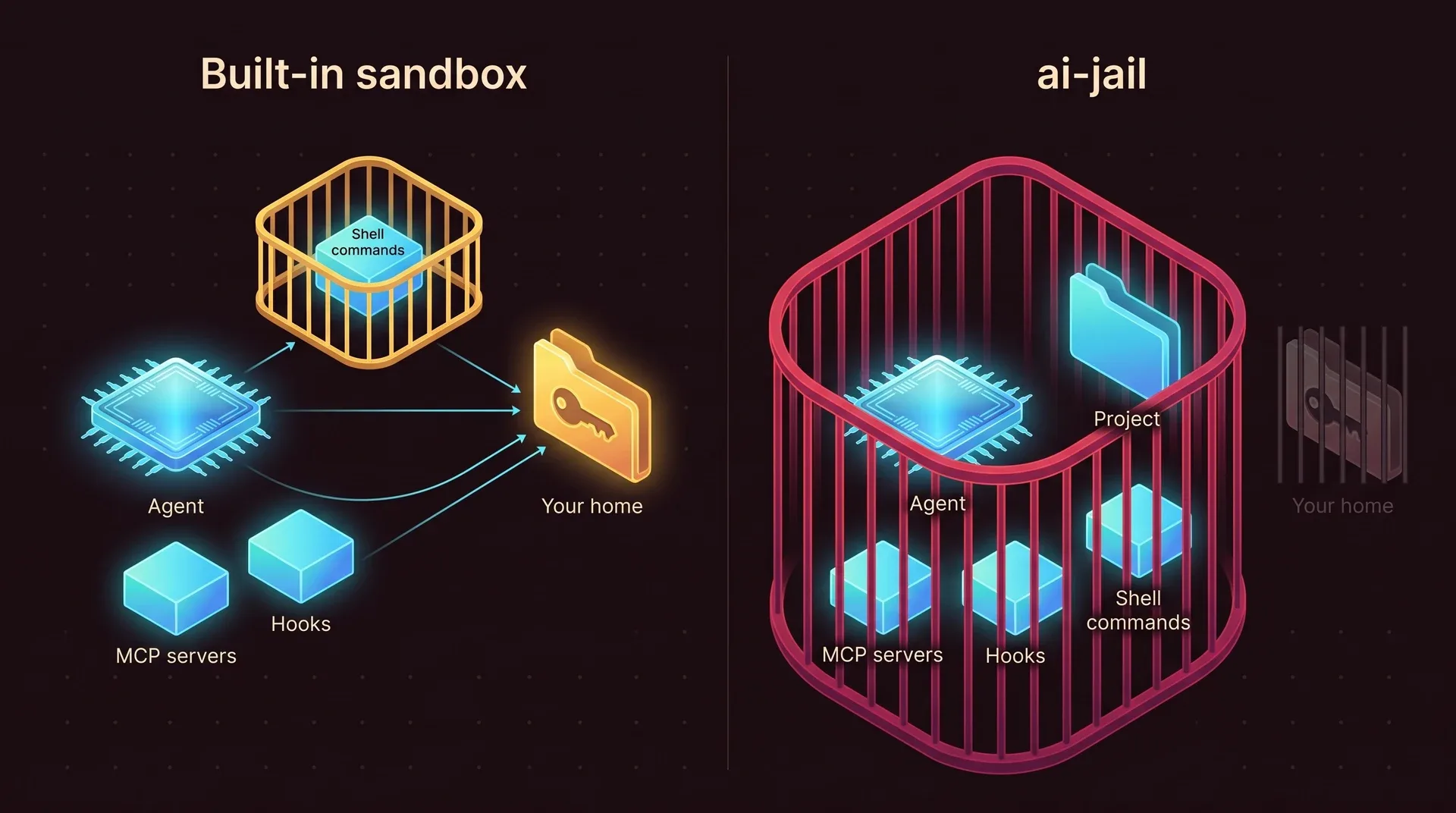
Codex also sandboxes the commands it spawns and leaves the codex process outside. Its documentation does not say where local MCP servers run.
A permission prompt is a different kind of protection
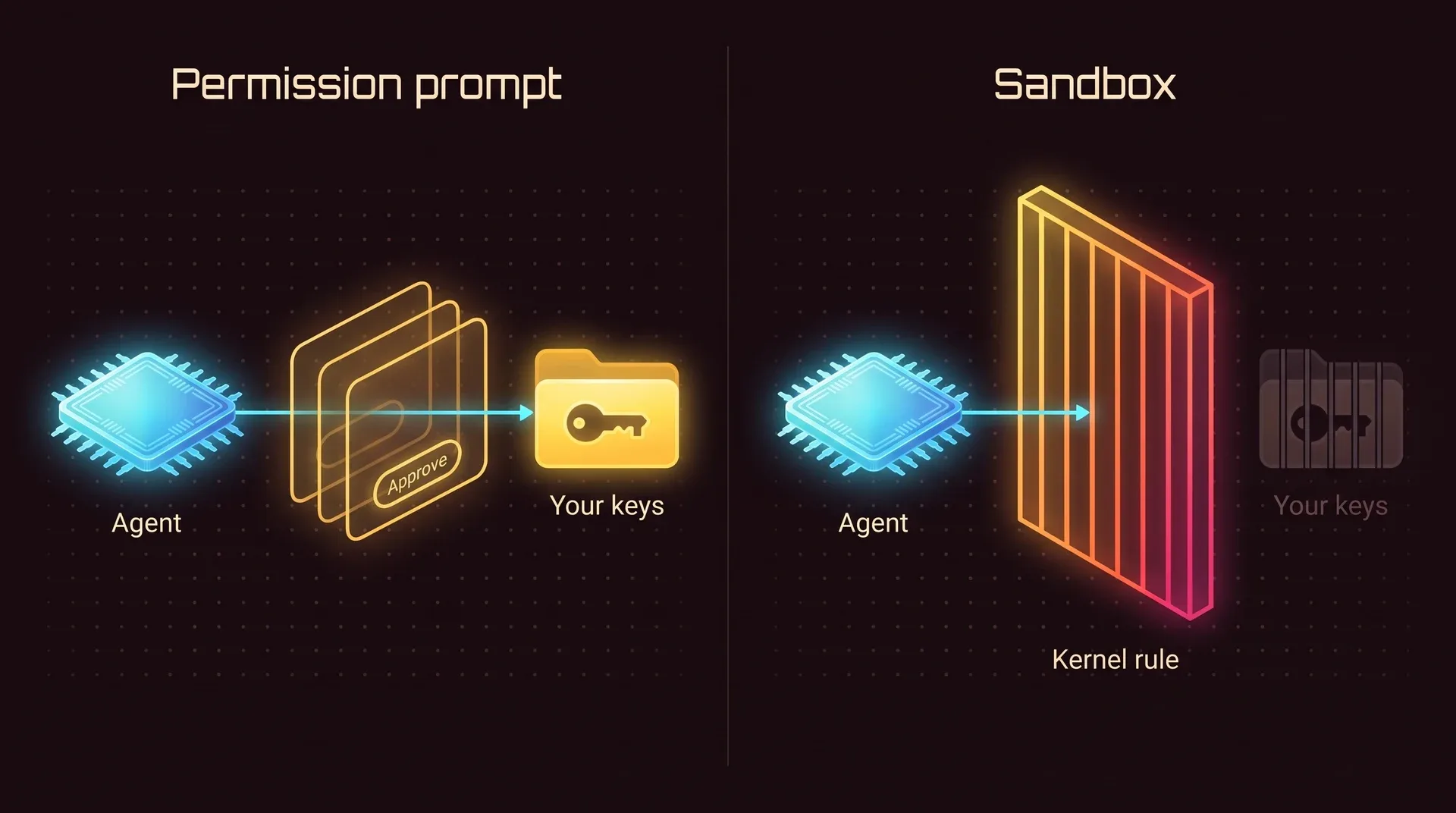
A prompt asks a person, and a person can be rushed or fooled. A sandbox asks the kernel, which gives the same answer every time.
Modes that take the person out
At the time of writing, each of these agents has a mode that stops asking. When the prompt is gone, the sandbox is the only protection left, if one is on.
| Agent | Mode | What the vendor says it does |
|---|---|---|
| Claude Code | auto | Everything runs and a second model reviews actions in your place. The documentation calls this classifier a per-action control, not an isolation boundary. |
| Claude Code | bypassPermissions, also --dangerously-skip-permissions | Everything runs with no checks. The documentation says to use it in isolated containers and VMs only. |
| Codex CLI | Approval policy never | The agent never asks. The sandbox mode still applies. See approvals and security. |
| Codex CLI | danger-full-access, or --yolo | The sandbox is off. With --yolo there are no approvals either. |
Side by side
Everything here describes each product's documentation at the time of writing. Where the documentation we read does not answer a question, the cell says so.
| Claude Code sandbox | Codex CLI sandbox | Gemini CLI sandbox | ai-jail | |
|---|---|---|---|---|
| What a wrapper around the whole agent adds | ||||
| What is inside the wall | Bash, PowerShell and Monitor commands and their children. The claude process, its file tools, MCP servers and hooks are outside. | The commands the agent spawns. The codex process is outside. Local MCP servers: not documented. | The whole CLI process, or only the shell and write tools with security.toolSandboxing. | The whole process tree: the agent, its file tools, MCP servers, hooks and every command. |
| On by default | No. You turn it on with /sandbox or sandbox.enabled. If a dependency is missing it warns and runs commands unsandboxed, unless you set sandbox.failIfUnavailable. | Yes. workspace-write is the default mode. | You turn it on with -s, GEMINI_SANDBOX or tools.sandbox. | It is on whenever you start the agent through it. If the configuration is invalid it refuses to start. |
Can sandboxed code read ~/.ssh by default? | Yes. The documentation says the default still allows reading credential files such as ~/.aws/credentials and ~/.ssh/. Deny rules are opt-in. | Yes on Linux, where the whole filesystem is mounted read only. Deny entries are opt-in. macOS default: not documented. | The default macOS profile, permissive-open, allows broad file reads. Stricter profiles are opt-in. | No. The agent gets a fresh, empty home directory. --ssh is an opt-in. |
| Environment variables | Sandboxed commands inherit the parent environment by default, credentials included. sandbox.credentials can deny or mask them. | Not documented | Not documented | A minimal allowlist of terminal, locale and toolchain variables. You add others by name with --env. |
| Escape hatch the model can use | The model may retry a command with dangerouslyDisableSandbox, which goes through the normal permission flow. allowUnsandboxedCommands: false turns that off. | With the on-request policy the agent asks to leave the sandbox for edits outside the workspace or for network. | Not documented | None. You set the policy before the agent starts, and a project's own .ai-jail file can tighten it but never open it. |
| Works with every agent | Claude Code only | Codex only | Gemini CLI only | Any command, with one policy file for all of your agents. |
| What the built-in sandboxes do better | ||||
| Network model | A proxy with a per-domain allowlist. A new domain prompts you. The documentation notes that domain fronting can bypass it. | Off by default in workspace-write. One setting turns it on, and an optional proxy adds per-domain allow and deny rules. | The default profile allows network. Stricter and proxied profiles are opt-in. | All or nothing. It is off by default, and --network opens all of it. It has no per-domain filter, on purpose. |
| Approval for each command | Yes. Permission modes, a plan mode, a classifier model and managed organization policy. | Yes. Approval policies, per-category rules and an optional reviewer agent. | Not documented | None. ai-jail never sees individual commands and never asks. |
| Protected paths inside the project | Yes. .git/hooks, .git/config, .claude settings, .mcp.json, shell rc files and more stay read only. | Yes. .git, .agents and .codex under writable roots are read only. | Not documented | None built in. The whole project is writable. You mask or deny paths yourself with --mask and deny_paths. |
| Hiding secrets from the agent while still using them | Credential masking can inject the real secret at the proxy. It needs an experimental setting. | Not documented | Not documented | No. A masked file is an empty file. |
| Platforms | macOS, Linux, WSL2. Not native Windows or WSL1. | macOS, Linux, WSL2 and native Windows. | macOS Seatbelt, Docker or Podman, gVisor, LXC (experimental) and native Windows. | Linux and macOS. On Windows, WSL2 only. |
| Install | Ships with the agent. On Linux it needs bubblewrap and socat. | Ships with the agent. | Ships with the agent. The container backends need Docker or Podman. | A separate binary. On Linux it needs bubblewrap. |
Sources: Claude Code sandboxing, Claude Code sandbox environments, Codex approvals and security, Codex Linux sandbox, Gemini CLI sandbox.
Use both
With the network off, a cloud agent cannot reach its own model API. In practice you open two things: the network and the agent's login.
cd ~/Projects/my-appai-jail --network --agent-state claude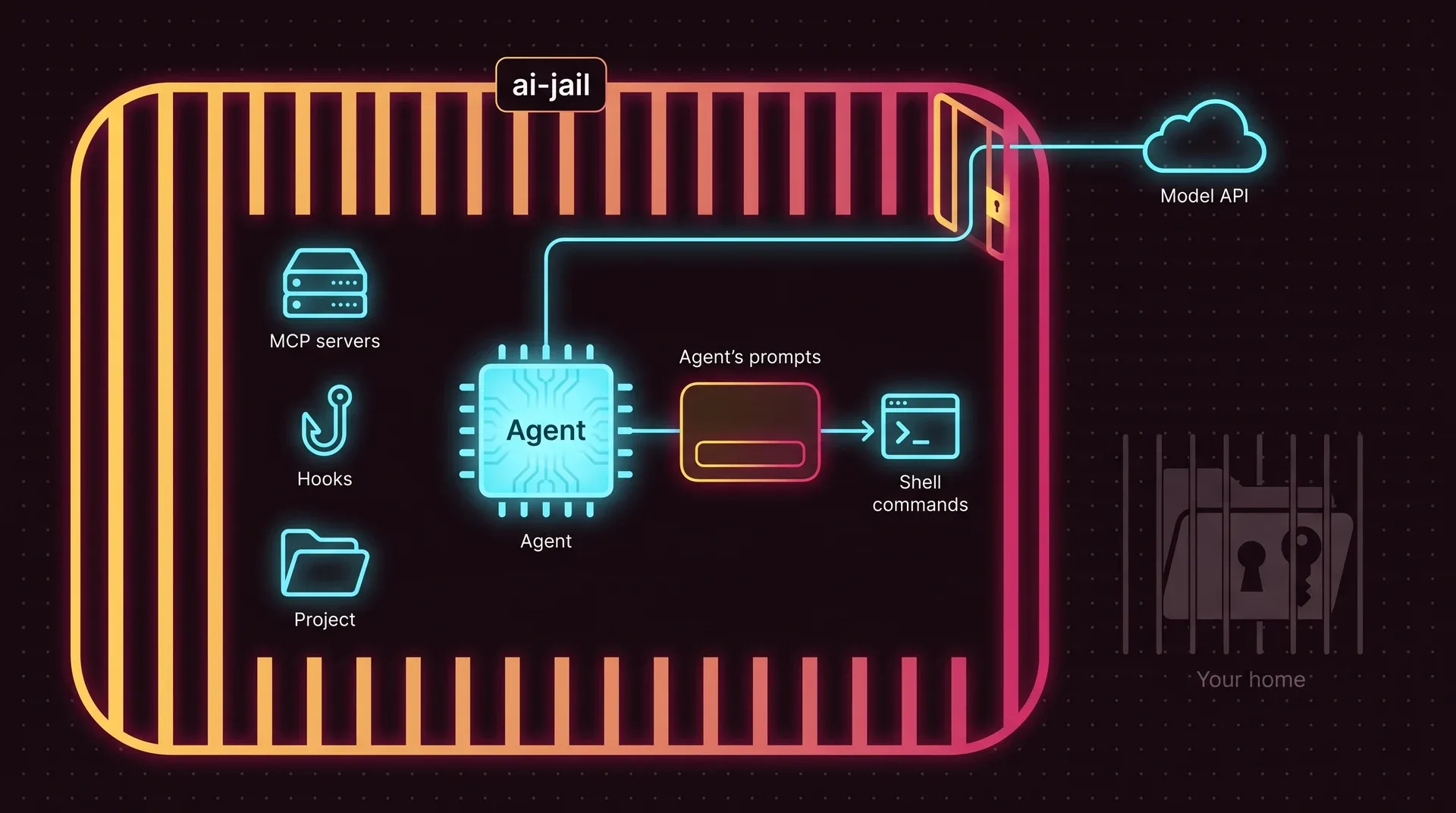
What the agent's own checks still do
Permission prompts, allow and deny rules and plan mode are part of the agent program, so they work inside the jail as they do outside. They catch the command you would not have approved.
What ai-jail guarantees underneath
The agent, its MCP servers and its hooks never see your home directory, your keys or the tokens in your shell, whatever you approve. What the agent can read, it can still send, so mask the secrets inside the project.
Docker, dev containers and virtual machines
These are good answers too, and a virtual machine is a stronger one. They differ in what you have to build and keep up to date.
| What it gives you | What it costs | |
|---|---|---|
| Docker container | Its own filesystem, process list and network. The agent sees only what you mount. | An image to build and maintain, with your toolchains installed a second time. If you mount the Docker socket, the container is root-equivalent on the host. |
| Dev container | The same isolation as a container, described in a file your editor understands and your team can share. | The same image upkeep, plus an editor or tool that understands the format. |
| Virtual machine | Its own kernel. It is the strongest boundary here, and the right one for code you believe is hostile. | The heaviest option: a guest system to install, update, give memory to and copy your project into. |
| ai-jail | A sandbox around one command, using the compilers and runtimes already on your machine. It needs no image, daemon or root. | It shares your kernel, so a kernel or driver exploit is outside its boundary. It is weaker than a virtual machine. |
ai-jail's own documentation calls it a useful layer, not a replacement for a disposable VM. Read the threat model.
Questions about running them together
Should I turn off my agent's own sandbox and prompts?
Is ai-jail safer than Docker?
Why is there no per-domain network allowlist?
IPAddressAllow=, or a container or VM that owns the network namespace.I only use Claude Code. Do I still need ai-jail?
@anthropic-ai/sandbox-runtime, a beta research preview, wraps the whole process. ai-jail wraps the whole process too, starts with your home directory and environment variables closed, and uses the same policy for any other agent you try later. See Anthropic's comparison of sandbox environments.Put your agent behind bars
ai-jail is a single binary that needs no daemon and no root. You add one word in front of the command you already run.
brew tap akitaonrails/tap && brew install ai-jailai-jail claude